Recently, I watched a YouTube video about pursuing one’s passions—a topic that has intrigued me for a long time. Over the years, I’ve developed some personal insights that have shaped my own career growth, and I’d like to share them with you in the hope that they might be helpful.
TLDR
If you have only one overlap, choose what you love.
A. Finding a common ground with the video
What do you like?
- The activities you naturally gravitate toward, even without prompting, often reveal what you genuinely enjoy. When this is paired with a strong desire to improve in those areas, you can be confident it’s something you truly love. Whatever that is for you, it’s likely your passion.
- For me, it was building mental models of the world and decision frameworks for various situations.
- Specifically, it involved analyzing situations to make informed choices.
- It was diving into Excel, mastering strategy games like League of Legends, and sharpening my problem-solving skills.
- It was writing and sharing my ideas with others.
- But above all, it was the continuous process of planning, reflecting, and learning—always striving to make better decisions in life.
- So, what activities naturally draw your focus and inspire you to improve? What is it that you love doing?
B. Expanding the ideas explored in the video
1. The intersection of passion, skill, and need
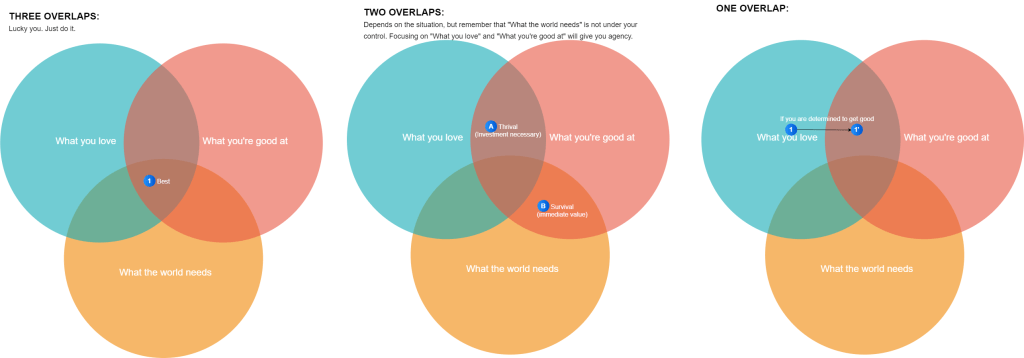
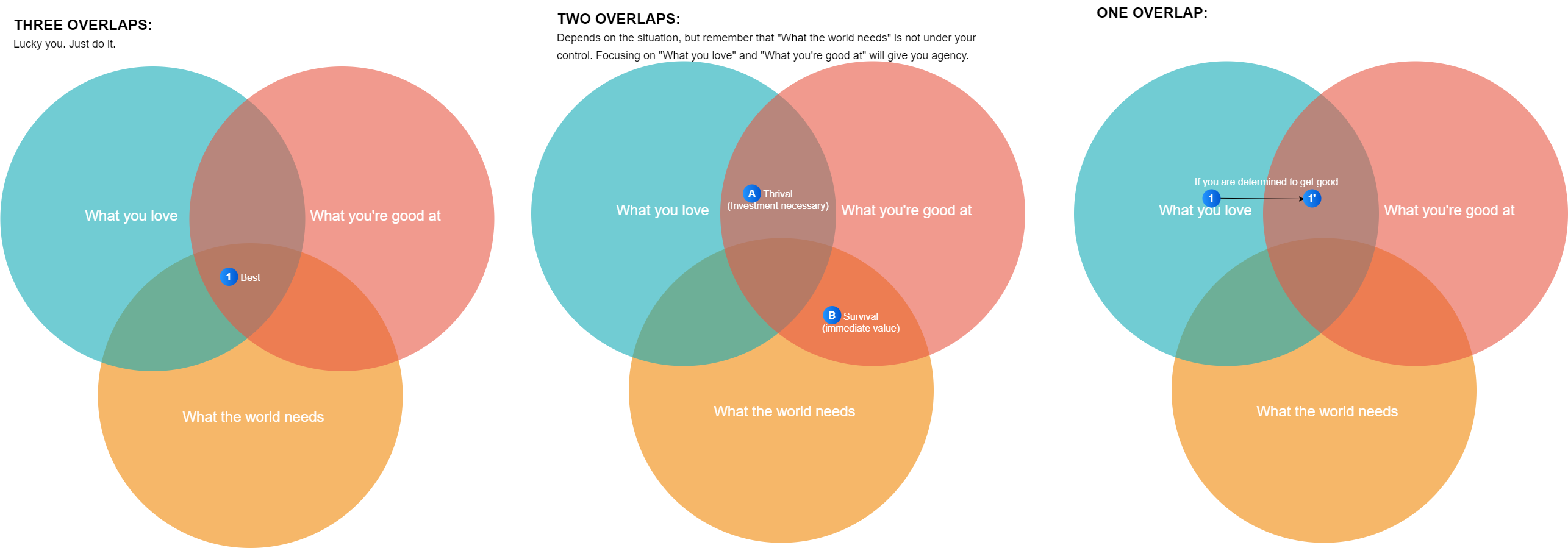
- If you had to choose just one aspect from the intersection of what you love, what you’re good at, and what the world needs, it should be what you love. The reason is simple: when you’re passionate about something and committed to improving, that passion can develop into mastery, eventually covering both what you love and what you’re good at.
- Ideally, if you identify something that fits all three criteria early in life, there’s little to deliberate (e.g., Warren Buffett and investing). Lucky you. Go for it!
- If two aspects overlap, prioritize what you love and what you’re good at. Relying too heavily on what the world needs can create a dependency beyond your control. In a mid- to long-term career, aligning too closely with external demands may lead you to chase trends instead of developing deep expertise. Societal changes and technological advancements shift rapidly, and fads rise and fall like ocean waves. If you can’t distinguish the signal from the noise—which most of us can’t—relying on the unpredictable is a recipe for an unfulfilling life.
- If only one aspect aligns, choose what you love. With dedication and continuous improvement, your passion can evolve into something you excel at. Besides, even if you don’t yet have a specific skill you’re good at or one that the world particularly needs, you likely have something you enjoy doing—and that’s a strong foundation to build on.
2. Follow those just ahead of you
- One of the key lessons I’ve learned from a decade of playing competitive ranking games like chess and League of Legends is that trying to emulate someone far beyond your current level is rarely effective, as you can’t fully grasp the nuances behind their decisions.
- Instead, focus on learning from those just ahead of you. For example, if you’re in the top 25%, aim to learn from players in the top 15%. This incremental approach consistently proves to be the most effective path to mastery. In the business world, this strategy is often referred to by the more polished term: benchmarking.
- When a post, video, or book resonates with you, it’s worth taking a deeper look into the author’s background—whether through their LinkedIn profile or other professional details. This habit of studying people you admire and internalizing their strengths can accelerate your own growth.
- To maintain focus and motivation, consider compiling a one-page document with the names and faces of those you aspire to emulate. Revisit it regularly and update it as needed. This list can serve as a powerful motivational tool, reminding you of the specific people and qualities that inspire you to improve.
- Often, 80% of the effort in accomplishing any task lies in convincing your monkey brain that it matters. Think about how focused you become when an important exam is just days away. Similarly, visualizing the people you aspire to be and regularly reminding yourself of their accomplishments provides far more motivation than vague goals of self-improvement. This kind of concrete imagery offers a tangible source of inspiration, helping to strengthen your resolve and accelerate your progress.
3. Even high achievers have 24 hours a day
- No matter how extraordinary someone like Elon Musk may seem, he, too, has only 24 hours in a day. He dedicates his time to what he considers most important, meaning he isn’t in direct competition with you—unless, of course, you’re vying for the position of CEO at Tesla, SpaceX, or X.
- Even if Musk were a better cook than you, it wouldn’t matter because he wouldn’t spend his time cooking, making him irrelevant as a competitor in that context.
- Similarly, a lack of exceptional talent in a particular area shouldn’t stop you from pursuing what you love. Using cooking as an example, not having the talents to become the world’s best chef doesn’t mean you should give up on your passion for it. You could still aim to become the most beloved ramen chef in Seoul by (i) using your above-average social media skills to promote your business, (ii) building customer loyalty with your ability to remember faces, and (iii) sharing your warmth by smiling more often and offering freebies.
- The key is to leverage the strengths you already possess to carve out your own unique niche. By doing so, you reduce direct competition with the truly gifted and fully capitalize on your distinctive abilities.
 Insights to Decision