The Career That Survives AI: Learning How to Learn (and Apply)
I. Inequality is growing, and automation is accelerating—so preparation beats prediction.
Anthropic’s latest Economic Index report confirms two trends I’ve been sensing:
- In enterprises, AI is used more for automation than for supplementing humans—77% of API usage is automated.
- Rich countries are racing ahead while poorer countries lag; per-capita leaders use Claude multiples beyond what population alone would predict.
I can’t judge the whole world state, but I can prepare for what’s coming.
II. Education & science sit right behind coding—AI is being used to learn and execute.
Coding still dominates (≈36%). Right behind it are education and science, which are also the fastest-growing categories. That signals something important: people are using AI not just to produce but also to absorb knowledge—to learn and execute as both consumers and producers of insight.
From a career standpoint, the only durable role is to be a professional learner and executer. With AI acting as a personal tutor, the bottleneck isn’t access to information anymore—it’s drive. Where progress once leaned on innate aptitude, the new formula for impact feels simpler: Clarity × Drive, amplified by AI. It’s no longer about raw intelligence, but the clarity to ask the right questions and the drive to pursue the answers.
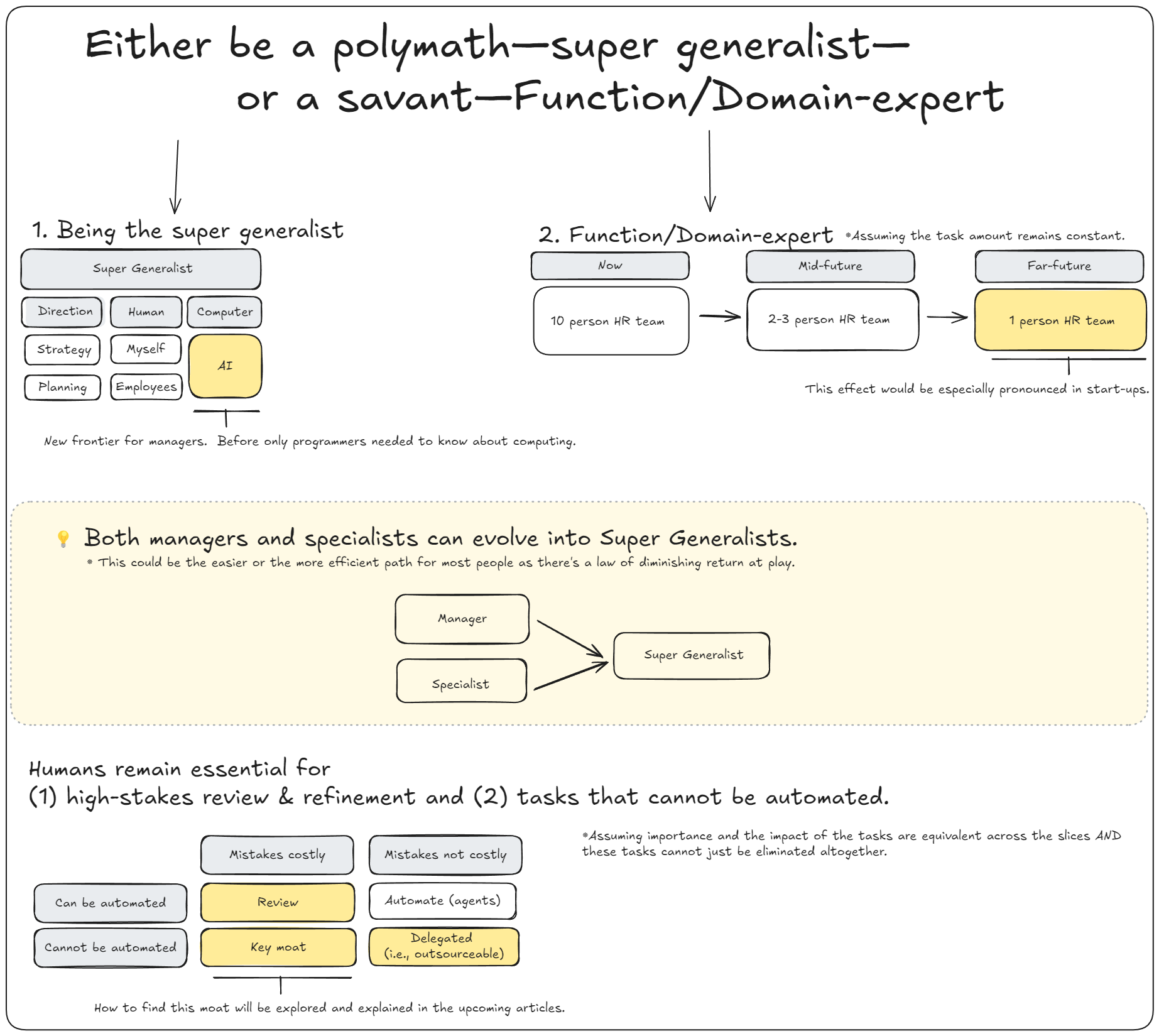
This reality shapes two viable paths for survival:
- The master generalist (polymath).
- On the business side: command the entire business stack—from marketing and finance to operations—and be comfortable with automation and coding, handling everything short of hyper-specialized roles like legal counsel.
- The deep expert, in flexible, fractional forms.
- Be the go-to specialist for hard problems while generalists handle routine work (think “fractional” models in finance/ops).
Here’s a visual breakdown of these roles and how humans remain essential:
III. Capital’s leverage was already rising before LLMs; AI just intensifies the dynamics.
Even before generative AI, big data and programming were widening returns to capital and to scarce technical skill. LLMs don’t create that stress—they amplify the systems already in place. As automation expands, capital’s leverage rises further. That’s why you’ll hear louder debates about robot taxes and redistribution as societies look for balance.
IV. Why I chose a decisive pivot into full-time study—and why I’m returning now.
I’ve had a lifelong-learner mindset since 2014, but learning on the side while working was too slow. To keep pace with the scale and speed of change, I decided to apply that learning at full intensity—not after hours, but as the center of my day.
That’s why I made a decisive pivot to study full-time, accelerating three things:
- Applying learning skills in depth, not just breadth.
- Developing stronger business and strategic judgment.
- Sharpening my analytics and statistics foundation.
I’m graduating soon and stepping back into industry in roles spanning business/strategy/planning, PMO, business analysis, product ownership, or finance. I’m returning with the mindset of a professional learner and executer—ready to compound learning inside the role, make decisions, bring discipline, and be the adult in the room when execution matters most.
Closing Thought: AI amplifies drive, not IQ.
AI won’t raise your raw intelligence, but it massively amplifies what you do with it.
Whether you become a Swiss-army-knife generalist or a go-to expert, the job is the same: learn with clarity and execute with drive. The upside is that first-mover advantage is more accessible than ever. You don’t need a huge team to start; you can delegate to AI, move faster than larger contenders, and build a moat through speed, accuracy, and applied learning.
The career that thrives is built on relentless learning and execution. I will make sure to follow-up with concrete examples of how to apply AI to learning in this new age.
 Insights to Decision