Executive summary
- Falling AI prices do not guarantee cheaper work. Reading more material and taking more steps can increase usage faster than prices fall. Providers are also passing more of that cost to users.
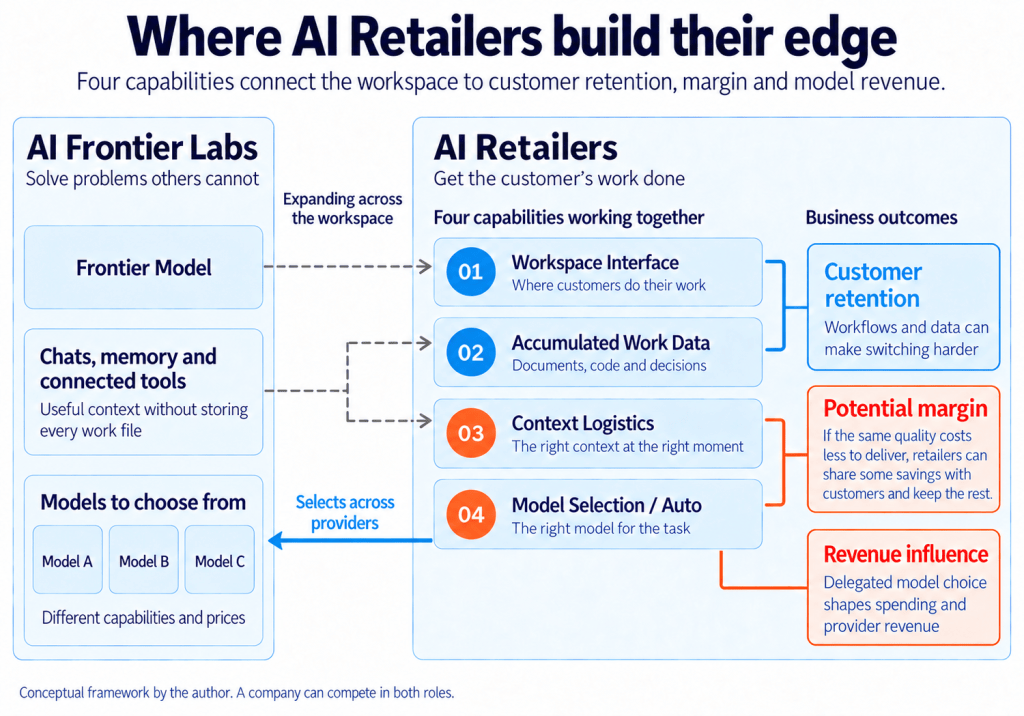
- Two sources of competitive advantage stand out. Frontier labs sell intelligence that solves problems others cannot. AI Retailers use models from several providers, including non-frontier models, to get customers’ work done.
- An AI Retailer’s trench comes from four capabilities working together: the workspace, accumulated work data, Context Logistics and model selection.
- Model selection can create margin and influence. Delivering the same quality at lower cost lets AI Retailers share savings with customers and retain part as margin. When customers delegate model choice, AI Retailers also influence which providers earn revenue.
Unit prices fall while spending can rise
Buying a given level of AI capability keeps getting cheaper. Finishing a task does not automatically get cheaper with it: the task may involve more reading, more steps and more attempts. The business opportunity lies in lowering the cost of a useful result.
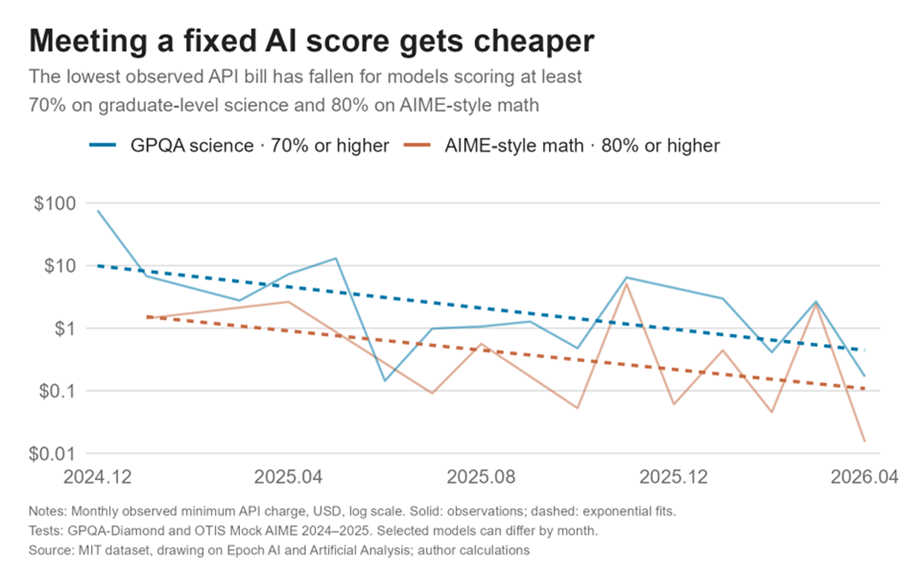
The price of meeting a fixed AI performance target is falling. After adjusting for differences in GPQA scores, the MIT study estimated that benchmark run prices fell to roughly one-fifth per year. The target stays fixed; the model meeting it and its price can change. MIT study
GPQA tests AI on graduate-level physics, chemistry, and biology. AIME is a U.S. student math competition; the math data in this chart use OTIS mock exams designed in the style of AIME.
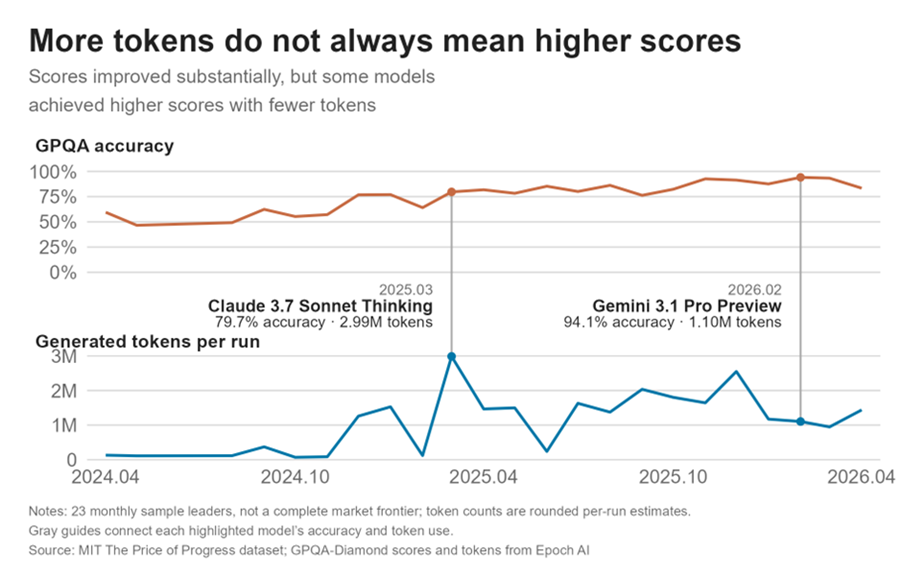
Across the models in Figure 2, more generated tokens did not always come with a higher score. Claude 3.7 Sonnet Thinking scored 79.7% with about 2.99 million tokens per benchmark run; Gemini 3.1 Pro Preview scored 94.1% with about 1.10 million. Scores improved substantially, but token counts alone do not tell you which model will deliver the result you need. Study data
More context does not automatically mean better answers, either. In the experiment in Figure 3, longer inputs hurt the model’s ability to connect clues much more than its ability to find matching words. The model could read more tokens and still do a worse job. Context experiment
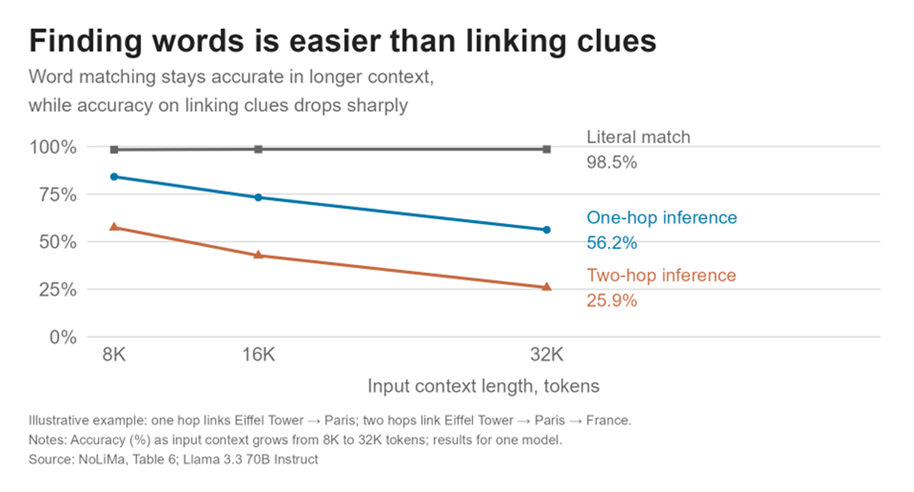
Here, one hop means using “Alex lives next to the Eiffel Tower” and the link Eiffel Tower → Paris to find who lives in Paris. Two hops add Paris → France to find who lives in France (an illustrative example).
The strongest model overall is not necessarily the best model for every task. Models are optimized for different kinds of work, so their strengths vary. Extra reasoning time and tokens add cost; they are worth paying for only when they improve the result enough.
Pricing adds another pressure. Subsidized usage can attract customers and build habits, but the subsidy becomes harder to sustain as those customers ask AI to do more work. GitHub said it had absorbed much of Copilot’s rising inference cost before moving to usage-based billing. Longer agent sessions made that cost harder to carry. GitHub announcement
These examples point to the same business problem: controlling the cost of a useful result as AI takes on more work.
Two sources of competitive advantage
Two sources of competitive advantage stand out. Call them “trenches” for now; how long they last is still an open question.
The first is intelligence that solves problems others cannot. That is the value frontier labs sell.
This lead weakens when competitors catch up or customers stop needing more intelligence. The DeepSeek and Kimi moments showed how quickly confidence in a frontier lead can be shaken.
The “good enough” threshold varies sharply by task. Where GPT-5.6 Terra already meets the required quality, paying for more intelligence may add little value.
The second is the ability to use AI from several providers to get customers’ work done. Businesses such as Notion, Microsoft with its Copilot products, Cursor and GitHub Copilot fit the term “AI Retailers”: they bring models into the tools customers use and turn those models into a service. The right model for a job need not be a frontier model.
Their trench depends on how well they combine four capabilities.
1 The place where people work
This is where customers already write, code and collaborate. When AI completes work inside those familiar tools, using it becomes part of the routine. The AI Retailer has an advantage before the customer even chooses a model.
2 The data that accumulates
Documents, code, decisions and finished work build up over time. Moving that history and a team’s workflows is harder than switching models. Notion and Microsoft have a head start here: they already hold much of the work surrounding the model. That is an advantage model benchmarks miss.
Google adds an integrated case: its own Gemini models sit inside Workspace products such as Gmail, Docs and Drive. The same workspace and data advantages can reinforce a company’s model business, too. Gemini for Google Workspace
Frontier labs are also competing for accumulated work data and Context Logistics through chats, project memory and connected tools. They do not need to host every work file to access useful context and preserve continuity between tasks.
ChatGPT Projects keeps chats, files and instructions together across devices. Claude Cowork’s Dispatch lets users assign tasks from a phone to an awake desktop, using its local files and connected tools. Claude Code’s Remote Control lets users continue a local session from another device. These are different ways to keep the AI involved as work moves between devices. ChatGPT Projects · Claude Cowork Dispatch · Claude Code Remote Control
Cursor’s Origin shows the same expansion in coding. Currently in early beta, it is a GitHub-like place where teams store code and collaborate. Cursor Origin
The move gives Cursor a place in both the work itself and the record it leaves behind.
Early Perplexity illustrates the vulnerability: offering a choice of models is easier to copy than becoming the place where customers work every day and keep their results. Without that accumulated work, switching services is easier.
3 Finding and connecting the right context
Having data is only the start. Context Logistics means finding the relevant information and getting it to the AI at the right moment. The advantage comes from selecting and connecting the useful pieces, rather than feeding the model everything.
Microsoft uses Graph to draw on relationships among emails, documents and people in search. Notion says it scaled its vector search infrastructure tenfold while cutting costs by 90%. As data grows, finding the useful pieces accurately and cheaply becomes more valuable. Microsoft · Notion
4 Choosing the right model
GitHub Copilot gives paid users a 10% discount on model costs when they let Auto choose. Its routing considers task complexity and model availability. The business logic is straightforward: use a model that can do the job efficiently, and reserve more expensive reasoning for work that needs it. How Auto works
If the same quality costs less to deliver, an AI Retailer can pass some savings to customers and keep the rest. The discount makes delegation attractive; the cost reduction creates room for margin.
AI Retailers are also launch channels for model providers. When xAI released Grok Code Fast 1, it offered the model free for a limited time through GitHub Copilot, Cursor and other services. That puts a new model directly into a workflow where customers can try it. Launch announcement
Model choice is work in its own right. A familiar everyday model and a stronger backup are simpler to manage than a changing lineup. Running into a usage limit may prompt a switch, but that is a poor substitute for matching the model to the task from the start.
The choice also extends to how much effort a model spends. Anthropic’s own guidance recommends tuning model and effort choices against the quality, speed and cost a task requires. This is another decision an AI Retailer can help manage. Anthropic’s model-selection guide
As customers delegate those decisions, AI Retailers gain influence over both customer spending and model-provider revenue. Copilot’s Auto discount encourages that handover. The AI Retailer increasingly decides which provider gets the work.
Notion and Microsoft start with a strong position because customers already work and accumulate data in their products. Cursor and GitHub Copilot are building a similar combination around code. Frontier labs are moving into the same territory through their own products and access to context.
The commercial test is whether these businesses can turn that position into reliable results at an attractive cost. Model-selection margin will be one test of how long the trench lasts, alongside customer retention and the quality of Context Logistics.
The same logic extends beyond office work and coding to other recurring workflows that combine customer context with model choice. The next competitive edge may belong to whoever gets the job done reliably—and keeps enough of the savings to build a business.
Appendix Bibliography
Anthropic. “Assign Tasks from Anywhere in Claude Cowork.” Claude Help Center. Accessed September 12, 2026.
Anthropic. “Choosing the Right Model.” Claude Platform Docs. Accessed September 12, 2026.
Anthropic. “Continue Local Sessions from Any Device with Remote Control.” Claude Code Docs. Accessed September 12, 2026.
Cursor. “Origin.” Cursor Docs. Accessed September 12, 2026.
Epoch AI. OTIS Mock AIME 2024–2025. Dataset. Hugging Face. Accessed September 12, 2026.
GitHub. “About Copilot Auto Model Selection.” GitHub Docs. Accessed September 12, 2026.
Gondi, Preeti, Mickey Liu, Nathan Louie, Calder Lund, and Jacob Sager. “Two Years of Vector Search at Notion: 10x Scale, 1/10th Cost.” Notion, February 19, 2026.
Google. “Gemini for Google Workspace Customer Resource.” Google Workspace. Accessed September 12, 2026.
Gundlach, Hans. Algorithmic_Progress_Inference. GitHub repository. Snapshot c34454ed, July 4, 2026.
Gundlach, Hans, Jayson Lynch, Matthias Mertens, and Neil Thompson. “The Price of Progress: Price Performance and the Future of AI.” arXiv:2511.23455, version 2, March 23, 2026.
Mathematical Association of America. “MAA Invitational Competitions.” Accessed September 12, 2026.
Microsoft. “Semantic Indexing for Microsoft Copilot.” Microsoft Learn. Last updated April 23, 2026.
Modarressi, Ali, Hanieh Deilamsalehy, Franck Dernoncourt, et al. “NoLiMa: Long-Context Evaluation Beyond Literal Matching.” arXiv:2502.05167, version 3, July 9, 2025.
OpenAI. “Projects in ChatGPT.” OpenAI Help Center. Accessed September 12, 2026.
Rein, David, Betty Li Hou, Asa Cooper Stickland, et al. “GPQA: A Graduate-Level Google-Proof Q&A Benchmark.” arXiv:2311.12022, November 20, 2023.
Rodriguez, Mario. “GitHub Copilot Is Moving to Usage-Based Billing.” The GitHub Blog, April 27, 2026.
xAI. “Grok Code Fast 1.” August 28, 2025.
Chart sources and trend method
Figure 1 uses 15 months of observations meeting GPQA-Diamond 70% and 11 meeting OTIS Mock AIME 2024–2025 80%. Monthly coverage varies, so observed minima need not equal the cheapest option in the whole market. Charges are estimated from token usage and historical API rates; they are not providers’ compute costs.
A fixed performance target does not mean a fixed model. Accuracy measures how many answers are correct; efficiency measures the resources needed to achieve that accuracy. New models and repricing can both lower charges. This chart cannot separate hardware improvements, model or serving efficiency, and price competition.
Figures 1 and 2 adapt MIT snapshot c34454ed: scores and tokens from Epoch AI, prices from Artificial Analysis. The suspect July 2024 Qwen3 date is excluded from both; the suspect December 2025 GPT-5.2 medium price is excluded from Figure 1. Figure 2 has 23 monthly observations, with generated tokens normalized using inferred run counts. Because accuracy is capped at 100%, token and score growth multiples are not directly compared. Derived and evaluation data use CC BY 4.0; price-source fields retain Artificial Analysis’s terms.
Figure 1’s exponential fits had the lowest leave-one-out log-cost error among dollar-linear, exponential, and log-quadratic candidates. They are descriptive, not forecasts, and separate from the paper’s one-fifth-per-year estimate. Figure 3 uses one model from NoLiMa, Table 6; multiple-choice conditions are omitted.


One response to “Where AI Retailers Get Their Competitive Edge”
JetBrain seems to be already following the ‘AI Retailer’ business model:
Lean back with AI in IntelliJ IDEA
LikeLike