Full PDF
Full Article
Horror box office since 2000, and what the directors behind its cheap jackpots made next. Data as of 29 September 2026; all 2026 figures are provisional.
My first dream job was to be a movie director, and I thought my first film should be a horror film. Not necessarily because I love horror, but because I knew horror movies make money, and they welcome new directors. So when I heard that Obsession had earned $519 million worldwide on a meager $1 million budget, I wanted to know two things. Is horror really where cheap films hit it big? And do the directors behind those films keep hitting, and only in horror?
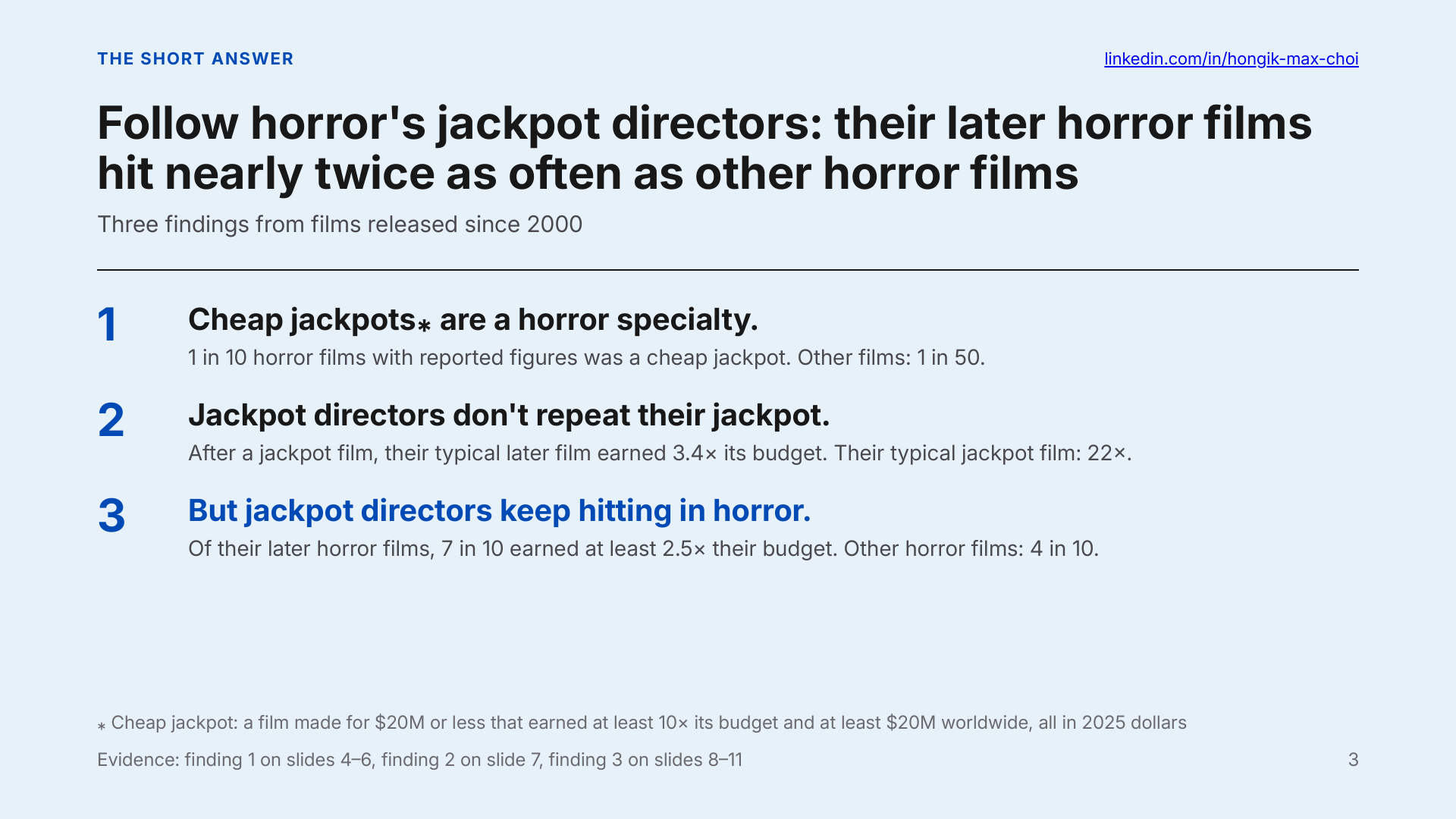
The short answer: follow horror’s jackpot directors. Their later horror films hit nearly twice as often as other horror films: 71% against 39%.
Three findings support it.
1. Cheap jackpots are a horror specialty
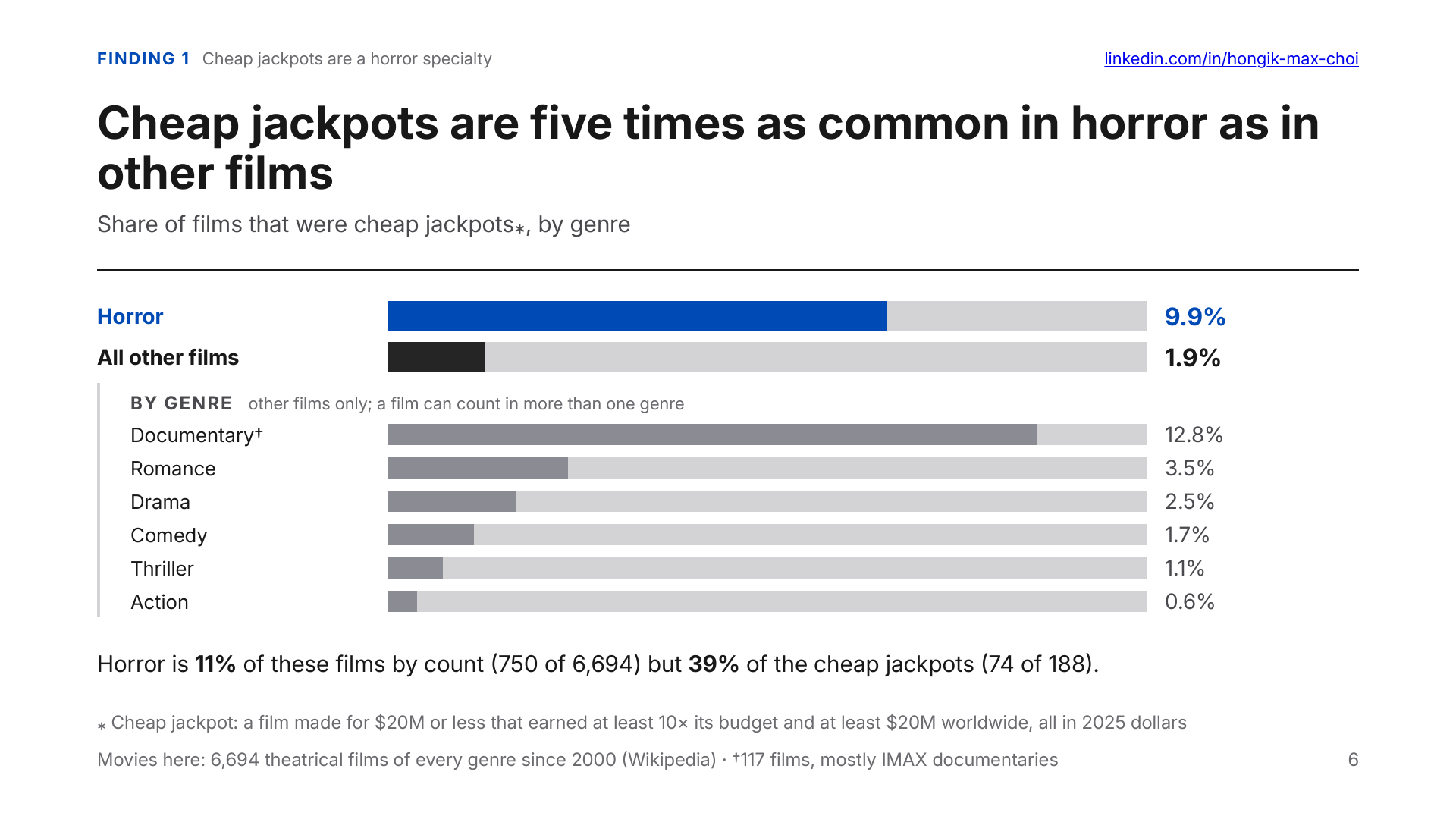
I call a film a cheap jackpot if it was made for $20 million or less and earned at least 10 times its budget and at least $20 million worldwide, all in 2025 dollars.
Among horror films released since 2000 with a reported budget and worldwide gross, 1 in 10 was a cheap jackpot. For other films, it’s 1 in 50. Cheap jackpots are five times as common in horror as in other films. Horror is 11% of films with reported figures but 39% of the cheap jackpots.
At the extreme, a few horror films made for under $1 million earned hundreds of times their budget (using the high end of each budget):
- Obsession (2026): a $600,000–$750,000 budget, $519 million worldwide so far (692 times its budget)
- One Cut of the Dead (2017): a $25,000 budget, $31.2 million worldwide (1,248 times)
- Paranormal Activity (2009): a $15,000–$450,000 budget, $194.2 million worldwide (432 times)
These are rare even among the jackpots: only 8 of horror’s 74 cheap jackpots since 2000 cost under $1 million.
Horror is also a decent bet overall. Of 759 horror films with reported figures, 47% were hits, earning at least 2.5 times their budget, which is a rough breakeven once marketing is paid. Another 21% earned 1 to 2.5 times their budget, and 32% earned less than their budget.
2. Jackpot directors don’t repeat their jackpot
I followed the 58 jackpot directors: directors whose first film on my list of horror’s biggest hits since 2000 was a cheap jackpot. (The list is horror’s 104 biggest hits: the 74 cheap jackpots plus 30 top-grossing horror films that weren’t cheap jackpots.)
Lightning rarely strikes twice. Their typical jackpot film earned 22 times its budget; their typical later film earned 3.4 times. Those later films were also more expensive: the typical next film cost 3.2 times the jackpot film’s budget, and 30% cost five times as much or more.
3. But jackpot directors keep hitting in horror
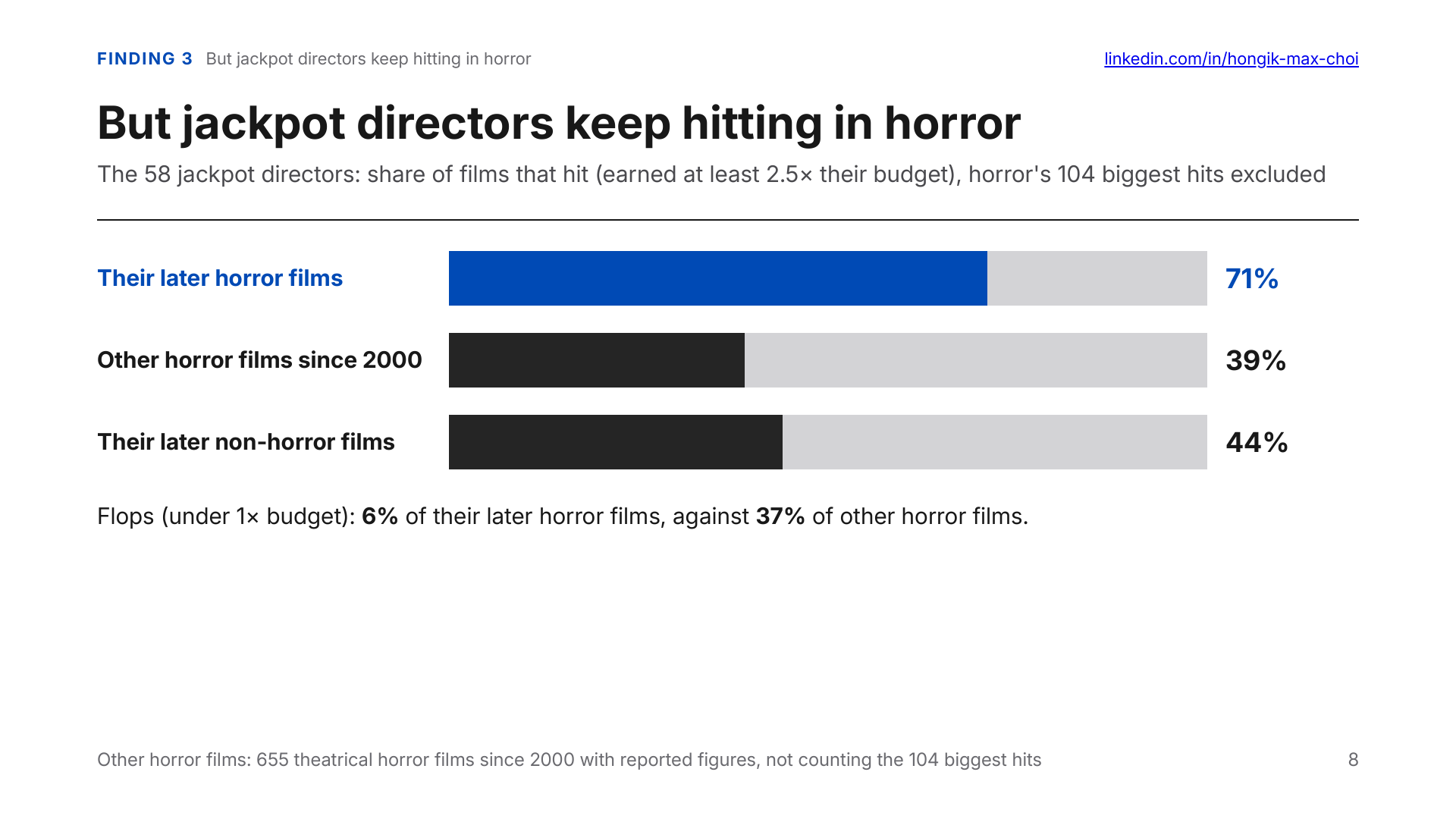
3.4 times the budget is still a hit. Leaving out horror’s 104 biggest hits on both sides, jackpot directors’ later horror films did far better than the other 655 horror films since 2000:
- 71% of their later horror films were hits, against 39% of other horror films.
- Only 6% of them flopped (earned less than their budget), against 37%.
- Outside horror, the edge fades: 44% of their later non-horror films were hits, well below their horror films.
Budget doesn’t explain the edge. At $20 million or less, 71% of their later horror films hit, against 40% of other horror films. Between $20 million and $60 million, the figures were 67% and 42%.
The edge comes mostly from horror franchise films (sequels, prequels, spin-offs, reboots and remakes): 84% of those hit. Their original horror films hit 47% of the time, which still beats other horror films’ 39%.
Three examples, counting every horror film after each one’s jackpot film (Saw, Cabin Fever, Get Out); unlike the 71%, these counts include horror’s biggest hits:
- James Wan (Saw, Insidious, The Conjuring): 4 of 6 later horror films were hits; the best, Insidious, earned 67 times its budget.
- Eli Roth (Cabin Fever, Hostel, Thanksgiving): 4 of 5 were hits; the best, Hostel, earned 17 times its budget.
- Jordan Peele (Get Out, Us, Nope): 2 of 2 were hits; the best, Us, earned 13 times its budget.
What to do about it
Back jackpot directors in horror. Few leave it: of the 58, 23 stayed in horror, 18 mixed in other genres, and only 7 moved away (10 have no later film yet).
Watch the four latest jackpot directors. Each made a cheap jackpot in 2026, so none has a second film out yet:
- Curry Barker, Obsession: $600,000–$750,000 → $519 million
- Kane Parsons, Backrooms: $10 million → $401 million
- Ian Tuason, Undertone: $500,000 → $21.6 million
- Mark Fischbach (“Markiplier”), Iron Lung: $3 million → $51.2 million
Three of the four have a horror franchise film lined up, the kind of film where jackpot directors hit 84% of the time.
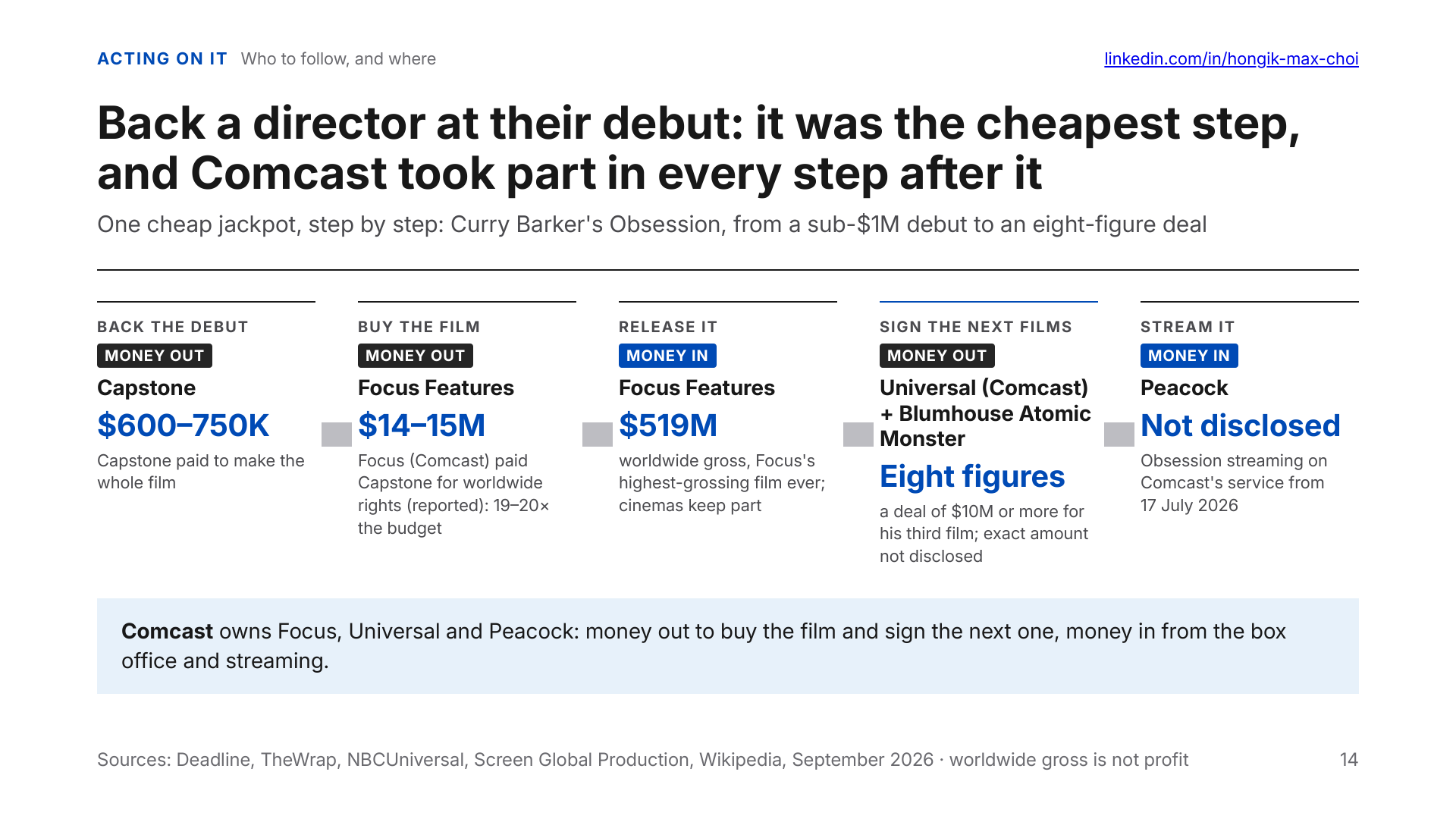
Back a director at their debut, the cheapest step. This bet rests on horror’s 1-in-10 jackpot odds, not on the 71%. Follow the money on Obsession:
- Capstone paid $600,000–$750,000 to make the film.
- Focus Features, owned by Comcast, reportedly paid Capstone $14–15 million for worldwide rights: 19–20 times the budget.
- The film grossed $519 million worldwide, Focus’s highest-grossing film ever; cinemas keep part of that.
- Universal (Comcast) and Blumhouse Atomic Monster signed Barker to an eight-figure deal for his third film.
- Obsession has streamed on Comcast’s Peacock since 17 July 2026; the fee wasn’t disclosed.
The debut was by far the cheapest step, and Comcast took part in every step after it.
How I did it, and its limits
The data covers 759 theatrical horror films from any country, released from January 2000 to September 2026, each with a reported budget and worldwide gross; the comparison with other films uses 6,694 such films of every genre. For the 58 jackpot directors, I collected every later film through 29 September 2026: 210 films, of which 105 had reported figures and could be scored. Horror films come from English Wikipedia’s horror categories; the jackpot directors’ later films are labelled with IMDb’s genre tags (Wikipedia-based labels move some numbers, not the findings).
I did this with the help of AI agents. Every number in the findings deck (linked below) is checked by code against a single facts file built from the data.
Read the findings as a pattern, not as cause, profit or exact figures:
- Pattern, not cause. These are comparisons between groups of films, not an experiment.
- Breakeven, not profit. 2.5 times the budget leaves out marketing costs; it is a rough breakeven line.
- Gaps in the data. Half of the jackpot directors’ later films were streaming-first or have no reported figures, and small releases often report no budget, so the rates lean toward better-documented films.
- 2026 is still moving. All 2026 figures are provisional; several films are still in cinemas.
The full findings deck (25 slides, with method, limits and a full bibliography) is here.
Sources: English Wikipedia (revision-cited), trade press (Deadline, TheWrap, Variety and others), MPA and Cinema Foundation reports, and the US Bureau of Labor Statistics (CPI-U). Information courtesy of IMDb (https://www.imdb.com). Used with permission.

